Last week we a lengthy discussion in class about the pros and cons of online grades. There were strong opinions on either side. Personally, I am for online access to grades. I would appreciate having such a system, simply because it would give me a better idea of what subjects I need to focus on improving in. There is nothing wrong with the idea of online access in principle; at heart the system is intended to provide a more convenient way to see one's grades, a goal I think all can agree with. Most of the objections that were raised in class can be answered by proper design of the actual system. I think that there is a way to create online grades that will satisfy all.
One of the most common objections to an online grading system raised by students was the possibility that parents would use the system to constantly track every grade fluctuation, and criticize them over every sub-par test, every missed homework. This problem is easily solved; instead of posting grades for every assignment, an online system could instead show only the overall average. This would be easier on teachers, and remove the threat of helicopter parenting.
The second major issue with the concept of online grades was raised by Mr. O'Connor and Mr. Bolos, who argued that such a system would reduce the interaction between students and teachers; instead of having a conversation about their progress, students could check a webpage instead. That point is valid for some subject areas. Doing well in English and Social Studies is a complicated goal, and requires a great deal of teacher-student dialogue to understand how to improve one's ability to use ideas and arguments. For other subjects, however, performance in the class is based almost entirely on understanding of a certain amount of material; the names of the phylums of animals, for instance, or how to use set builder notation. For math and science especially, talking to a teacher about grades inevitably involves them only looking up and telling you your current grade. The problem is that performing well in math or science, while difficult, is not complicated. The only help, other than answering specific questions, that your teacher can give you is to tell you to study harder, and learn the material better. I'm not trying to say that I am against teacher-student interactions; I'm just saying that the negative effects of online grades can be significantly less for some subjects.
To solve this problem, I think it should be possible to allow teachers to opt out of any potential future system. This would satisfy those teachers who believe their classes would not benefit or be harmed by online grades, and give those teachers who wished to participate a more convenient alternative to frequently handing out grade reports. This would also help teachers with grading structures not compatible with frequently updating averages.
Most issues with online grading can, I believe, be solved with proper design of the eventual system. If anyone has thoughts on this issue or agrees or disagrees with my points, feel free to comment below.
Tuesday, December 13, 2011

Tuesday, December 6, 2011
King Cotton and King Corn

"No power on earth dares make war upon it. Cotton is king." (James Henry Hammond)
"For decades, nearly every candidate who hoped to win the presidency has visited this state to pledge their allegiance to King Corn." -LA Times
Last year in geography, we watched a movie called "King Corn," about the huge role corn plays in American life, both as a food and a fuel. When I read the above line from the slavery chapter in Foner, I immediately made a connection. The ability to make money leads to political power, and valuable crops make money. This fundamental principle applies no matter when or where the situation is, equally applicable in the 18th century and the 21st century. The plantation owners controlled the economy of the south; the livelihood of an entire region depended on their crops and their exports. Because they had the money, they were the most powerful men of the south, and as a result their crop was untouchable. These conditions are the setting of Douglass's narrative. The furious opposition of white plantation owners to the abolition of slavery is because it would severely hamper their ability to make money. The entire issue of slavery is, in a sense, a result of cotton, and the money and power it gives to those who farm it.
Corn has a similar power in modern America. The government provides subsidies to corn farmers and ethanol producers, and for a long time few Republicans or Democrats dared to challenge those subsidies, for fear of political repercussions. The issue is especially important because the first state to have a caucus for presidential nominations, Iowa, is a major producer of corn, and benefits enormously from the subsidies. Corn today wields a similar power to cotton in the 19th century. The ability to make money can have a huge effect on politics and government, no matter when or where the situation is.
Source:http://articles.latimes.com/2011/aug/11/nation/la-na-ethanol-20110812
Image: http://www.worldcommunitycookbook.org/season/guide/corn.html
Last year in geography, we watched a movie called "King Corn," about the huge role corn plays in American life, both as a food and a fuel. When I read the above line from the slavery chapter in Foner, I immediately made a connection. The ability to make money leads to political power, and valuable crops make money. This fundamental principle applies no matter when or where the situation is, equally applicable in the 18th century and the 21st century. The plantation owners controlled the economy of the south; the livelihood of an entire region depended on their crops and their exports. Because they had the money, they were the most powerful men of the south, and as a result their crop was untouchable. These conditions are the setting of Douglass's narrative. The furious opposition of white plantation owners to the abolition of slavery is because it would severely hamper their ability to make money. The entire issue of slavery is, in a sense, a result of cotton, and the money and power it gives to those who farm it.
Corn has a similar power in modern America. The government provides subsidies to corn farmers and ethanol producers, and for a long time few Republicans or Democrats dared to challenge those subsidies, for fear of political repercussions. The issue is especially important because the first state to have a caucus for presidential nominations, Iowa, is a major producer of corn, and benefits enormously from the subsidies. Corn today wields a similar power to cotton in the 19th century. The ability to make money can have a huge effect on politics and government, no matter when or where the situation is.
Source:http://articles.latimes.com/2011/aug/11/nation/la-na-ethanol-20110812
Image: http://www.worldcommunitycookbook.org/season/guide/corn.html
Wednesday, November 30, 2011
SOPA
As I'm sure everyone knows, we have been studying restrictions on liberties quite in depth recently. I just remembered something i read about a while ago, about restrictions on the internet; a bill currently being considered in congress called the "Stop Online Piracy Act." The act would allow the government to blacklist sites that are accused of copyright violation; blacklisted websites would be blocked by internet service providers, search engines, advertising networks, and payment providers. The party doing the accusing would not be required to prove that copyright was actually infringed, and websites would be punished without a warrant, a requirement of due process, or any sort of oversight by the court system.
The powers the proposed law would give to the government immediately reminded me of the cases during the war on terror in which terror suspects were incarcerated without trials or even charges against them. In both cases, a the government ignores the right to due process; the Guantanamo prisoners and the accused websites are punished without proof of guilt or oversight by an independent institution.Of course, the government's actions are much more significant when they destroy lives, rather than wrongfully shutting down websites In addition, the guarantees to due process, trial by jury, and the rest in the constitution apply only to people accused of crimes, but the principle is still the same. In the case of SOPA, the government hands out punishments despite not knowing whether the accused is truly guilty.
Source: Here
Source: Here
Tuesday, November 22, 2011
Political Cartoon

Yesterday in class we spent a period discussing parallels and contrasts we found in the text of The Crucible. A good parallel takes a small and seemingly insignificant repeated word or theme found in the text, and uses it to illustrate a broader point or message that the author was trying to convey. When I did my 555s, I had some trouble picking out the important details, those which could be used to create parallels. Because of this, I decided to practice a little at picking up on significant details. I Google searched “political cartoons,” and chose the second result, above. The website I found it only said that it was published between 1900 and 1948, although based on the images I assume it was created during the 1930s. The overall message is fairly blatant; the various powers of the world are using the League of Nations to control the U.S. However, there is a slew of smaller details in the image, many of which have greater meaning. Here is my attempt to pick out small, specific details, and what message the cartoonist is trying to convey with them.
-The only two countries represented individually, other than the U.S., are England and Japan
The author is clear about the two nations he blames most heavily for attempting to control the U.S., and by only giving these two countries their own caricatures, he directs his message most strongly at them
-England is separate from “European Powers”
The cartoonist views England as unique and seperate from the continental powers of Europe, despite it technically being a part of the European continent.
-Britain, Foreign Powers, and European Powers are all portrayed as fat men
The other world powers are shown in a negative light. The image of a fat man has connotations of corruption and "oldness," or being out of date and petty.
-Japan is portrayed as a skinny man with a mask
The view of Japan at the time was as a mysterious, foreign country, as evidenced by the Japanese man's mask and foreign clothing, as well as the contrast that caricature presents with the other men in the cartoon.
-America is the tallest man in the picture
The artist's point has a strong undertone of American superiority; America has the most flattering portyal.
The artist's point has a strong undertone of American superiority; America has the most flattering portyal.
-The U.S. is oriented lengthwise, starting with the Atlantic side, and neither Canada nor Mexico are in the picture
The cartoonist makes it clear that he is focused on America. He oriented the U.S. in such a way that it fills most of the map, and all the events of the cartoon occur on and around it.
If you notice any details I missed, feel free to comment.
The cartoonist makes it clear that he is focused on America. He oriented the U.S. in such a way that it fills most of the map, and all the events of the cartoon occur on and around it.
If you notice any details I missed, feel free to comment.
Tuesday, November 15, 2011
Rock the Casbah
A few weeks ago, I spent several hours creating the Animoto for I was responsible for the civil war group. We used a song by The Clash, "I Fought the Law." I chose that song mainly for the obvious connection between the chorus of the song, "I fought the law and the law won," and the themes of our presentation, and for how clear and understandable the lyrics are. After finishing the presentation, I looked through a few more songs by The Clash, and found some that were interesting, and dealt with themes of law and justice in more depth than "I Fought the Law," which is basically a repetition of the one line above for three minutes.One in particular that caught my focus was the song "Rock the Casbah," which is the video above. The full lyrics can be found here.
What I initially noticed, listening, was the link between the events of the song and the Arab Spring, about which I have written on this blog in the past. The song deals with repression and resistance in the Arab world and presents many parallels to the current revolt. There is one significant difference between the dictatorship in the lyrics and those involved in the revolutions up to this point; The Clash's repressor is a theocratic government analogous to those of Saudi-Arabia or Iran, a government that uses religion as a tool to oppress and control its people. The dictators under pressure today, by contrast, are mainly secular despots that repressed religious organizations along with any other form of civil society that posed a possible threat to their power, with the semi-exception of Muammar Qaddafi.
On an in-depth examination, the narrative of the music is much more complex and detailed than a simple story of a king attacking his own people. The story touches briefly on an array of complicated issues, among them oil politics ("The oil down the desert way has been shaking to the top") and corruption of religion ("The sheik he drove his Cadillac").
Fundamentally, however, the song is a story about the basic human desire to express themselves. We have been discussing freedom of speech quite heavily in class recently with our perilous times unit. We have focused heavily on political speech and restrictions related to wartime necessity, but "Rock the Casbah" deals with speech that has direct relation to politics or social issues. The people are simply trying to choose what music they want to listen to. They are exercising one an extremely basic forms of self expression. The song makes the point about how difficult it is to suppress something so basic, and how human will can overcome even bombs and mass violence. The Clash are trying to say that no government can truly defeat the will of the masses, if they want a freedom. Most cases we have discussed in class ended with the successful infringement of some freedoms by the government, and in several cases the government appeared to abuse its power and unjustly restrict civil liberties. Applying the principle expressed by The Clash, all that is truly necessary to prevent such abuses is for enough people to stand up against them.
Monday, November 7, 2011
Clybourne Park
Last week, as I'm sure all of you know, we saw the play Clybourne Park, a comedy that deals with issues of race. When I thought about the play afterward, the scene that
thing that struck me the most was the contrast between the final scene of the
play, the one in which the son is writing his suicide letter, to the scene just
beforehand, the humorous racist-joke scene. The joke scene was the funniest of
the play, while the suicide-letter scene was the most serious and somber. In the first situation, a huge fight erupts
out of a slight perception of racism, while in the second scene a tragedy
unfolds unnoticed and unseen. The stark contrast between the scenes seems to
almost be an accusation; people become upset, and pay attention to issues of
race, while ignoring a real and terrible tragedy. Race shouldn’t matter, and
there is an obsession about differences that are only superficial, that aren’t
important at all in the grand scheme of things. In the meantime, true tragedies
unfold unacknowledged. Recently allegations surfaced that Herman Cain had
sexually harassed several women while working as the head of the National
Restaurant Association; it wasn’t long before some accused those who reported
on the claims as racists. Meanwhile, an article in the New York Times today
reported on three children who had been beaten to death over the past several
years by parents who had read a Tennessee pastor’s book on using corporal
punishment on children. That is the sort of tragedy that goes unacknowledged
for years, while people focus on race, and other things not deserving of
attention.
Monday, October 24, 2011
The LRA and the Colbert Report
The Colbert Report
Get More: Colbert Report Full Episodes,Political Humor & Satire Blog,Video Archive
Get More: Colbert Report Full Episodes,Political Humor & Satire Blog,Video Archive
Occasionally if I have a few spare minutes after doing homework, I will watch episodes of the Colbert Report. Personally, I think the show is very entertaining, and often gives surprisingly sharp and accurate critiques of politics and well known people. Last week, I saw this segment on his show. If you haven't watched it, do that now.
You may be familiar with the Lord's Resistance army from middle school, when, at least at WJHS, we watched a documentary called Invisible Children, about how the LRA abduct children and force them to become child soldiers. Or from reading news articles about the hundreds of atrocities they have commited in central Africa. And Rush Limbaugh criticizes Obama for trying to "wipe out Chrisitians."
In addition to being totally outrageous and terrible, Limbaugh's gaffe presents some cautionary lessons. First is the obvious importance of research. If Limbaugh had even bothered to Google search "LRA," he would have easily learned that they are war criminals and terrorist, not good Christians attempting to defeat dictatorship. Second is to avoid disagreeing with someone on an issue simply because of who they are. Despite what many in the Republican party might believe, Obama is not wrong on everything. In this incident, Limbaugh assumed that because Obama decided to send soldiers to help fight the LRA, they must be good people.
Wednesday, October 19, 2011
Egyptian Christians and Free Speech

cracy, by necessity, is rooted in ethnic and cultural separations, and that "Any sort of popular sovereignty [In the Middle east] has tended to unleash the furies and drive minorities into exile." I don't agree entirely with the author's conclusion, that there will be significant conflict and religious division in the next few years before a true Egyptian democracy emerges, but what really interested me in the article was the basic idea that democracy can cause civil strife.
The root cause of the conflict described in the article is an anti-Christian sentiment present in Egyptian society. It is not necessarily a common sentiment, and there are stories of Muslims demonstrating in solidarity with the Christians. However, it is one that is certainly present, and which has existed since long before Mubarak's fall. The advent of democracy, however allowed that sentiment to be expressed openly and acted upon.
Democracy, by its nature, is a political system which tends
to encourage anyone to speak their minds. This leads to both good speech and bad
speech. When you encourage everyone to speak out, some will
spread destructive messages. We have
been discussing similar free speech issues in class as well; When
does free speech become a harm to society? Egypt is an example of how allowing
everyone to voice their opinion can have negative consequences. I'm not saying
that free speech, or the accompanying democracy is a bad thing. It is just that
we have a tendency to view democracy as the perfect solution to the troubles of
a country. Although democracy (or technically democratic republics) may be the
best form of government so far, the conditions necessary for a healthy
democracy can cause their own set of problems.
Article:http://www.nytimes.com/2011/10/16/opinion/sunday/douthat-democracys-collateral-damage.html
Image Credit: New York Times
Friday, October 14, 2011
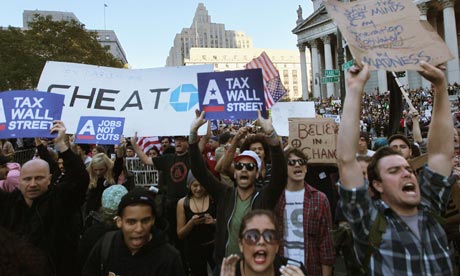
Occupy Wall Street
Monday, September 26, 2011
The Outsider's Place in Society
So far in American Studies, we have looked at two similar but also very different characters. Both Timothy Treadwell and Chris Mcandless were outsiders, and lived outside the normal bounds of American Society. For Treadwell, this was because he couldn't fit in, and for McCandless, because he didn't want to fit in. During our discussion, the question of whether the outsider, despite appearing to be apart from the mainstream, has a role in American society. Does the outsider have a place in society? When I thought about that question, I noticed that the best way to gauge how outsiders are perceived is through movies. The outsider is a staple template for many characters,
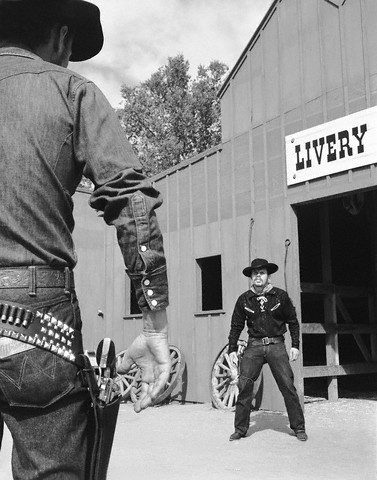 The most common outsider in movies is the awkward underdog who can't fit in, but eventually finds success, such as the main character of Forty Year Old Virgin. This sort of outsider is different from Treadwell or McCandless; the point of his story is to eventually become an insider and achieve happiness along the way. Treadwell and McCandless, by contrast, don't try to become insiders, but rather achieve happiness by focusing their lives around goals outside of the American norm. A closer analog to Treadwell and McCandless's character is the archetype of a protagonist of westerns; the sheriff or the lone ranger who wanders, dealing justice to those he meets. Like Treadwell and McCandless, these characters live apart from normal society, and their goals in life are very distinct from those of insiders. Instead of trying to raise a family or have a productive career, a sheriff dedicates his life to justice, as Treadwell dedicated his life to Grizzly Bears and McCandless to his pursuit of his ideals.
The portrayal of Western characters is highly positive. The characters, despite being total strangers, are treated as heroes. They live outside the conventional bounds of society, but they still have a large, valuable role in mainstream culture. A person doesn't necessarily have to conform to have a role in American Society.
It is important to note, however, the many differences between western characters and Treadwell and McCandless. The roaming sheriff is not a hero because he is an outsider, but because people strongly agree with his mission. Protecting Grizzly Bears and searching for universal truth are not regarded nearly as highly as fighting crime and saving the innocent, so the principle behind popular opinion of western protagonists doesn't necessarily apply to Treadwell and McCandless. However, I believe that many people do sympathize with their goals, and admire their motivation and purpose. Those that criticize them do so because they disagree with their methods, not because they disagree with the goals. They are not automatically shunned because they are outsiders, and are even admired by some. Outsiders can "fit in," in a way, to the culture they live apart from.
Picture Credit: http://www.23hq.com/splandigo/photo/5426761
The portrayal of Western characters is highly positive. The characters, despite being total strangers, are treated as heroes. They live outside the conventional bounds of society, but they still have a large, valuable role in mainstream culture. A person doesn't necessarily have to conform to have a role in American Society.
It is important to note, however, the many differences between western characters and Treadwell and McCandless. The roaming sheriff is not a hero because he is an outsider, but because people strongly agree with his mission. Protecting Grizzly Bears and searching for universal truth are not regarded nearly as highly as fighting crime and saving the innocent, so the principle behind popular opinion of western protagonists doesn't necessarily apply to Treadwell and McCandless. However, I believe that many people do sympathize with their goals, and admire their motivation and purpose. Those that criticize them do so because they disagree with their methods, not because they disagree with the goals. They are not automatically shunned because they are outsiders, and are even admired by some. Outsiders can "fit in," in a way, to the culture they live apart from.
Picture Credit: http://www.23hq.com/splandigo/photo/5426761
Wednesday, September 14, 2011
All News is Gossip?

Last week in class we had a discussion about a chapter of the book Walden, by Henry David Thoreau. He expressed a variety of strong opinions, but one in particular stuck in my mind. Thoreau was very dismissive of news, saying that "I am sure that I never read anything memorable in a newspaper," and that "all news, as it is called, is gossip" (69). Thoreau is criticizing those who read the newspaper for entertainment, and the specific events he references as unimportant are fairly trivial. Thoreau criticizes those who may literally gossip about the latest murder, the latest fire or accident, and so forth. In that he has a valid point, that it isn't desirable to read the news in order to entertain oneself with mundane events. The problem is, murders, accidents, and everyday occurrences are not the only subjects of newspapers. Thoreau would have also read about the Mexican-American War, the Indian Removal act and the subsequent conflicts, half a dozen revolutions in Latin America, and numerous other large-scale events. According to Thoreau, however, those events aren't memorable. Thousands of American and Mexican deaths, the violent expulsion of many native groups, and nations throwing off their colonial rulers in favor of self determination, are nothing but gossip. He took an idea he had about a subset of news, and applied it to all news, and, consequentially, almost any significant political or social event. These events are hugely significant, however. Both the Mexican-American War and the conflicts with Native Americans resulted in huge territorial gains and societal shifts, shaping the nation that Thoreau belonged too and in which we live today. I don't think many people agree that those events are merely gossip. Thoreau's statement is an example of a generalization that, beyond it's original subject matter, is inaccurate. It can be tempting to draw broad conclusions from specific cases, but those conclusions are very often wrong when attempting to describe different circumstances.
Image Credit; http://www.fodey.com/generators/newspaper/snippet.asp
Thursday, September 8, 2011
The Morality of Consumption, Part 2
 |
| A common example of consumption |
The production and sale of material objects comes at a cost as well. Every object created by humans comes at a cost to the natural world. The raw materials were taken from nature at some point, and their removal and transformation into a finished good invariably damages nature to some degree. Any pollution caused by the extraction and manufacturing process can have an negative effect on public health, a cost to society.
The effects of consumption are complicated, and vary greatly depending on what the material good is. According to the guidelines I set out, whether or not consumption is moral depends on what is consumed. For instance, purchasing a reed mat from a local vendor when on a trip to South America would definitely be a moral form of consumption, since the cost to the environment is almost nil, and the benefit to the vendor, who most likely has a low income, is so great. A private jet, by comparison, has huge costs to the environment with small benefits to the purchaser. The jet was made using metal that had to be mined, and manufacturing required use of large quantities of electricity, which was probably generated by burning coal, which also had to be mined. Every step of the creation of the jet came at a cost to both the world, and to public health because of pollution. All these costs result in the benefit of being able to avoid flying commercially. Because the costs are so high, I would consider purchasing a private jet immoral.
Of course, most day to day purchases fall somewhere between these two extremes. It would be impossible to answer the question definitively for every different object one could consume, but it seems to me that as long as an object is not needlessly extravagant or costly, and as long as the buyer does enjoy the object, in most cases the benefits will be greater than the costs.
Some costs of consumption, however, can't be linked to individual purchases. For example, consumption that is greater than a person's income can severely harm the overall economy. The current economic problems were partially caused by people taking out mortgages that they couldn't afford to repay. When they defaulted en-masse, it caused great damage, and contributed to the broader financial crisis. The problem is, a single home owner who consumed beyond his means can't be blamed for the broader crisis. It was only when many people made the same mistakes that the true cost was revealed. For that reason, it would be difficult to account for that sort of cost on a purchase to purchase basis.
Another way to answer the question would be to ask whether the money you spend could have a greater benefit if it was spent another way. Would it be moral, for instance, to buy a expensive car instead of a normal car, and donating the rest of the money to a local soup kitchen? One could argue that you are choosing not to feed the hungry, and are therefore responsible for their condition. Believing in this principle, however, raises difficult questions. Would it be immoral to buy any food other than rice, on the grounds that the extra money you spend on better food could better be spent on charity? The question of whether one should be held responsible for inaction, in this case failing to spend his or her money on the more needy, is too complicated to be adressed in this post.
I hope my analysis of the question was convincing. I didn't intend for the post to be this long, but it just sort of kept growing. Please let me know if you think any section is redundant, so I can edit for readability.
Image Credit: http://www.ers.usda.gov/AmberWaves/September08/Features/ObesityCountries.htm
Obama Quote Source: http://newyork.ibtimes.com/articles/173238/20110702/obama-ending-tax-breaks-required-to-cut-deficit.htm
Tuesday, September 6, 2011
The Morality of Consumption
While reading "Into the Wild," I found Chris's attitude toward money interesting. Chris "believed that wealth was shameful, corrupting, inherently evil" (115), and was embarrassed by his parents displays of it. The idea that spending money is somehow morally wrong has been around for quite a while. A dislike of the display and possession of wealth is a central tenet of communist philosophy, and even president Obama hinted at that idea when he decried "tax breaks for millionaires and billionaires, or for hedge fund managers and corporate jet owners, or for oil and gas companies." It does seem wrong, to some extent, that Americans to possess so much wealth and so many possessions while others in the world lack even the basics of life. So, is wealth really immoral?
I believe the argument that wealth and money itself is inherently immoral is extremely weak. The Bill and Melinda Gates Foundation, for instance, controls almost 34 billion dollars, but no one can argue that that wealth or the foundation is morally questionable. Rather, the strength of the case against the wealth of a person or entity depends on how it is used; the money may not be wrong, but using it for frivolous purposes may be. The most morally questionable use of wealth is also the most common use, at least at an individual level; to purchase material goods, i.e. consumption. Because the act of purchasing an iPod, for instance, has no direct benefits except the satisfaction of the buyer, and is not necessary for a comfortable existence, it is most vulnerable to questions about morality, at least compared to other uses for money. And so we finally arrive at the subject of the title of this post. Is the use of money to purchase material and luxury goods, also known as consumption, an inherently immoral act? (this post will be finished tomorrow, i'm still working on answering the question. in the mean time, if anyone wants to give an answer, i would appreciate the feedback.)
Subscribe to:
Posts (Atom)